The Record Behind the Goal
Salem Al-Dawsari's winner against Argentina made him famous in an afternoon. Becoming trusted took him far longer. After writing more than 400 profiles of Saudi names, I think the difference explains how reputation is actually made.

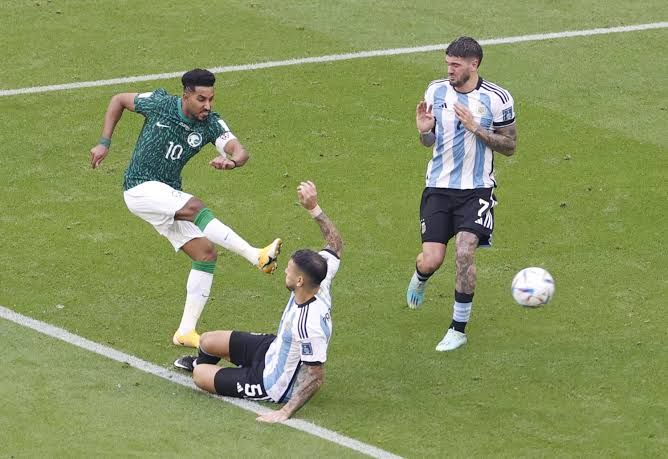
On 22 November 2022, at Lusail Stadium in Qatar, Salem Al-Dawsari struck a shot from the edge of the Argentine penalty area into the top corner. Saudi Arabia led 2-1. The score held. Argentina went on to win the World Cup, which made the result look stranger with every round that followed.
For much of the world, that afternoon was the first time it heard his name.
The goal is the moment most people remember. It is not the moment I find most revealing. That came eleven months later, in Doha, when the Asian Football Confederation named him its Player of the Year for 2022. The award was not for one shot. It covered a season in which he also helped Al Hilal reach the final of the FIFA Club World Cup, the first Saudi club to get that far. Two years later, in October 2025, he won the award again in Riyadh and became the first Saudi player to win it twice.
The goal made Al-Dawsari known. The record made him something harder to name. In Arabic I call it al-makana, standing: the degree to which other people are willing to rely on a name when its owner is not in the room. I have spent years writing about Saudi founders, executives, athletes, institutions and families, and the question I keep returning to is what turns the first into the second.
Where my evidence comes from
My answer comes from a body of writing rather than a laboratory. Across Arbaaa's platforms I have written more than 400 documented profiles of names in the Kingdom. I did not write them to test a theory. I wrote them to explain individual people. Only later did I start reading them together, the way a researcher reads field notes, looking for what repeats.
What repeats is a chain with three links. Actions become perceptions. Perceptions become reputation. Reputation changes how other people behave. The phrase I use with clients is shorter: documented, consistent actions toward a communicated vision and values. Each word in it covers a link that can break.
None of this is a law. It is a working model, and I will come to its weaknesses. But it explains Al-Dawsari's two moments better than anything else I know.
From action to perception
People rarely see actions directly. They see accounts of them. The sociologist Erving Goffman described public life as a performance read by an audience, and the economist Michael Spence explained why some performances are believed. A signal persuades when it is costly and hard to fake.
By that test, the Argentina goal was close to a perfect signal. It happened on the most scrutinised stage in the sport, against the eventual champions, in front of a live audience of many millions. Nobody could have staged it. It converted from action to perception within seconds.
Most consequential actions look nothing like that. A founder who pays salaries on time through ten difficult years has done something costly. A hospital director who quietly fixes a scheduling system has done something hard to fake. Neither action is seen unless someone records it and someone else reads it. That is why the word "documented" leads my definition. An action nobody has recorded has not yet entered the chain. It may be admirable. It cannot yet build anything.
From perception to reputation
A perception is one impression. A reputation is what remains after many.
Game theorists made this precise in the early 1980s. In work by David Kreps and Robert Wilson, among others, a reputation is the belief that observers form about someone's type from repeated behaviour. It is, in effect, a prediction. A single impression cannot support a prediction, however vivid it is.
This is where Al-Dawsari's two moments separate. For people who followed Asian football, the Argentina goal confirmed a judgment they had already formed. He came through Al Hilal's academy and made his first-team debut in 2011. Apart from a brief loan to Villarreal in 2018, he stayed. He won the AFC Champions League with the club in 2019 and 2021 and was named the competition's most valuable player in 2021. To that audience, the goal was evidence added to a file.
To the wider world, the goal was a discovery, and discoveries are fragile. A name met once can be forgotten by the next tournament. What the awards of 2023 and 2025 did was hand the second audience the file the first audience already had.
This is also the link where most reputation campaigns fail. A campaign works directly on perception. It can produce the same impression at enormous volume. But the same impression repeated a million times is still one impression. Volume creates recognition. It does not create a record, because nothing new has happened for the audience to update on. Virality does not build standing.
From reputation to behaviour
A reputation matters only when it changes what other people do. They hire, invest, invite, recommend, defer or forgive on the strength of it.
The sociologist Joel Podolny showed how status alters the terms on which others deal with someone. A trusted name pays lower costs in every transaction, because fewer people feel the need to check. Robert Merton described what follows. Credit tends to flow toward those who already have it, so standing, once established, compounds.
In Saudi Arabia, this third link often operates in rooms the person never enters. A board discussion. A majlis. A phone call in which one person asks another whether a name can be trusted. The answer to that call is what I call borrowed trust. The person who vouches lends their own standing, and loses some of it if the name later disappoints. My reading, from the profiles, is that this is one reason reputations in the Kingdom tend to be built slowly and lost quickly. Vouching is expensive for the voucher, so it is given carefully and withdrawn fast. That is an interpretation, not a measured finding, and I hold it accordingly.
The objections
The chain has obvious challengers, and some of them are partly right.
The first is inheritance. In Saudi Arabia, a family name can carry standing its youngest member did nothing to earn. Pierre Bourdieu called this symbolic capital, and it is real. My view is that inherited standing works like a loan against the family's record. It opens doors earlier. It does not exempt anyone from the second link. Once the door is open, the person's own actions are audited like everyone else's, and sometimes more strictly.
The second is money. Spending can buy visibility, and visibility can produce recognition. Whether recognition becomes reputation still depends on what happens next. Money can buy the first link. It cannot buy repetition.
The third is the single defining act. Some names are made by one moment and never tested again, and their fame lasts. I accept this. Fame can be durable without being deep. The test is whether people will rely on the name for something new.
The fourth objection is about my evidence, and it is the most serious. I mostly profile people who have already succeeded. I rarely see those whose actions were well documented and still went nowhere, so my corpus over-represents chains that worked. I also wrote the profiles myself, which means I am partly reading my own framing back to myself. The model is useful to me. Whether it holds beyond the names I chose is a question others will have to test.
What an essay cannot do
There is a reason this piece is an essay with my name on it rather than a profile. A publisher's account of himself cannot be independent, and readers are right not to treat it as such.
The same limit applies by the logic of the chain. This essay is an action. If it is read, it may become a perception. It cannot become a reputation on its own say-so. That requires repetition over years and other people willing to vouch for it, in rooms I will not be in.
Al-Dawsari's goal took a second. The judgment that followed it took twelve years and was made by other people. No one can award himself that second part. It is the only part that lasts.
Sources and editorial notes
Salem Al-Dawsari
- Saudi Pro League, "Salem Al Dawsari career in numbers" (spl.com.sa, 2023): academy graduate; Al Hilal debut 2011; winner in the 2-1 victory over Argentina at Lusail Stadium, 2022 World Cup.
- Arab News and The Peninsula, 31 October to 1 November 2023: AFC Player of the Year (2022 edition) presented in Doha on 31 October 2023; sixth Saudi winner.
- Gulf News, October 2025: first Saudi to win AFC Player of the Year twice; 2022 season included Al Hilal reaching the FIFA Club World Cup final, the first Saudi club to do so.
- The Peninsula, 17 October 2025: second award presented in Riyadh.
- Al Arabiya English, 5 May 2025: AFC Champions League MVP 2021.
- Wikipedia and FotMob player records: 2018 loan to Villarreal (one league appearance); AFC Champions League titles with Al Hilal in 2019 and 2021.
Theory
- Erving Goffman, The Presentation of Self in Everyday Life, 1959.
- Michael Spence, "Job Market Signaling," Quarterly Journal of Economics, 1973.
- David Kreps and Robert Wilson, "Reputation and Imperfect Information," Journal of Economic Theory, 1982.
- Robert K. Merton, "The Matthew Effect in Science," Science, 1968.
- Joel Podolny, Status Signals: A Sociological Study of Market Competition, Princeton University Press, 2005.
- Pierre Bourdieu, "The Forms of Capital," 1986.
Author's framework
- The action, perception, reputation, behaviour chain and the definition "documented, consistent actions toward a communicated vision and values" are the author's own. Full treatment in the Prince Researcher paper The Reputation Engine.
Classification of claims
- Verified facts: Al-Dawsari's career dates, awards and match result.
- Attributed theory: Goffman, Spence, Kreps and Wilson, Podolny, Merton, Bourdieu.
- Author's interpretation: the three-link chain; borrowed trust; inherited standing as a loan; the claim that campaigns act on perception and cannot produce a record.