The Uniform and the Runway
Within a single lifetime, Saudi Arabia narrowed a map of regional costumes into a national uniform. The thobe is now made in the Kingdom every day, on almost every high street. Who makes it, from what cloth, and whether that matters, is the least examined question in Saudi fashion.

In 1973, the painter Safeya Binzagr stopped selling her work. In 1968 she had been one of the first two women to hold a public art exhibition in Saudi Arabia. Now she chose to keep her paintings together as a single body of work, and over the following decades much of it turned toward a subject few others were recording: what Saudi women had worn.
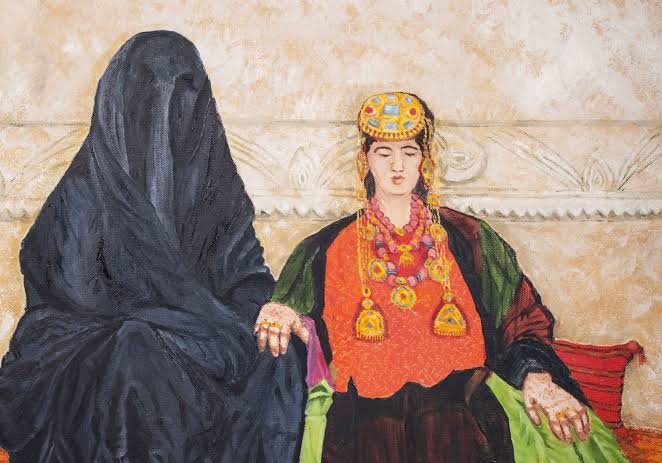
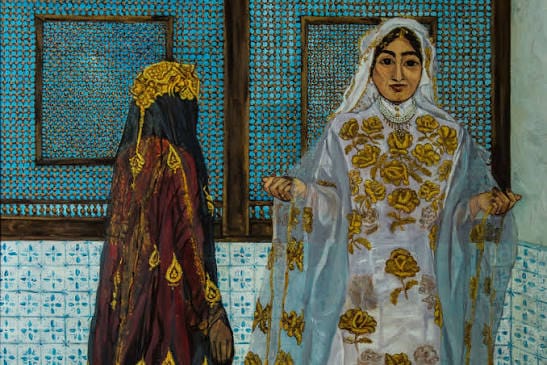
She travelled to every region of the Kingdom, often with her sister Thuraya. She asked families to donate old garments and searched archives abroad for photographs. She painted more than fifty watercolours of historic women's costumes, and displayed them beside mannequins in reconstructed clothes at the museum she opened in Jeddah in 2000, Darat Safeya Binzagr. The museum gives a practical reason for the work. Few references recorded what these garments looked like, how they were worn, or what they were called. Her collection became the basis of Darzah: 200 Years of Sartorial Heritage in Saudi Arabia, published by Rizzoli in 2024, the year she died.
Binzagr was racing a real change. A 1985 study by the Saudi researcher Al-Bassam, cited in later academic work, concluded that women's traditional dress had been transformed so completely that only the abaya survived, in new materials. What replaced the old costumes was not chaos but its opposite. Over the twentieth century, much of Saudi Arabia came to dress in a handful of national garments.
That uniform is usually discussed as culture. It is also an economy, and a large one. Millions of men buy several thobes a year, many of them cut to measure in neighbourhood shops. Yet the people who make Saudi Arabia's national dress, and the mills that weave its cloth, are almost never part of the story. Following the garments from Binzagr's watercolours to today's tailoring shops raises a question the Kingdom's young fashion industry has barely begun to ask. Does a garment have to be made at home to belong to a country?
A map of cloth
Before oil, Saudi dress varied by region, by town and desert, and by occasion. A heritage display in Jeddah today shows the range. From the Hijaz, the western region that includes Makkah, Madinah and Jeddah, come the women's zaboun dress and maharem headscarves, and the men's sidiriyah waistcoat and turban. From Al-Ahsa in the east comes the bisht, the men's cloak, finished with gilded zari thread. From the south come dresses and shirts stitched in bright thread and worn with silver jewellery.
The differences followed trade and movement. The Hijaz received pilgrims from across the Muslim world every year. A study of travellers' accounts by a researcher at Taif University traces how the Hajj season and the mixing of peoples shaped the variety, and even the names, of Hijazi clothing. One Hijazi dress in a documented collection is cut from pink Indian silk brocaded in silver and gold, work known locally as kantil. Binzagr observed that the zaboun was always cut the same way, but made from whatever cloth a family could obtain.
Even the outer garment looked different. The dress historian Reem El Mutwalli has described the pre-oil abaya as a square of sheer goat or camel wool, draped from the crown of the head. Binzagr's paintings of Hijazi weddings record brides in colourful dresses rather than white.
There was no fashion industry in the modern sense. But this wardrobe did much of what fashion does elsewhere. It signalled where a person came from, what they could afford, and what kind of day it was.
The narrowing
Over the twentieth century, much of that variety gave way to a small set of garments: for men, a white thobe with a ghutra or shemagh headcloth held by a black igal, and for women, a black abaya. The sources point to several forces acting at once. They do not allow the forces to be weighed against each other.
One was political. The Hijaz was incorporated into the Kingdom of Saudi Arabia, declared in 1932, whose ruling family and dominant social codes came from Najd, in the centre of the peninsula. The anthropologist Mai Yamani, whose family is from Makkah, devoted a chapter of her book Cradle of Islam to how Hijazi dress adapted to the new order. She describes pressure on regional customs to conform to central Arabian norms, and a counter-movement in which Hijazi families grew more conscious of their own heritage in dress, food and ritual.
Another was industrial. Mutwalli links the black abaya's dominance to commercial manufacture, which made one standard garment cheap and widely available. Curators at the Diriyah Biennale made a related point about a print series Binzagr produced in the late 1990s: set against today's clothing, her images show how mass production and globalisation changed traditional dress.
A third was enforcement. For decades the abaya was mandatory in public, and expected to carry no colour or ornament. Women interviewed by the Arab Gulf States Institute in Washington recalled growing up with only two styles, both black.
Men's dress narrowed too, and some of its most familiar elements are younger than they look. In a 2013 Arab News column, the Saudi writer Abdulateef Al-Mulhim recalled that his father's generation never wore the red-and-white checked shemagh. In his account, the pattern arrived from Britain within the previous half century, the white ghutra was sold by merchants as Swiss-made, and an earlier greenish headcloth had been standard for the old army and police. Saudipedia, the national encyclopedia, dates the shemagh's rise to the Kingdom's most common headcloth to the mid-1970s. A memoir column is not an archive. But the official dating points the same way.
The careful conclusion is this. The individual garments of Saudi national dress have deep roots. Their near-universal adoption, in a few standard forms, is largely a twentieth-century settlement.
What a thobe costs
The settlement produced a market with an unusual shape. Most of it can be seen in a single tailoring shop.
In October 2006, a week before Eid, an Arab News reporter visited thobe shops on Riyadh's Thalatheen Street. Shahid Mahmoud, a tailor from Pakistan, explained the seasonal rhythm. A thobe normally took a day or two. During Ramadan, customers were told to come back in a week, and shops stopped taking orders altogether as Eid approached. Customers ordered three or four thobes before the holiday and returned months later for more. A salesman at a neighbouring shop gave the arithmetic. Tailoring cost 80 riyals. The cloth, four to five metres of it, cost between 100 and 400 riyals, and determined the final price. A ready-made thobe could be bought for about 75.
Six years later, in Jeddah's Bani Malik district, the dressmaker Majid Alghamdi described his normal price of 100 riyals rising to at least 150 in Ramadan. A Riyadh textile importer, Tarik Ba Abbad, forecast a 30 percent rise in cloth prices that year. Customers blamed tailors, tailors blamed importers, and one shopper told the paper he saved money by buying cloth wholesale in Jeddah's old Balad market and carrying it to a tailor himself. In 2024, a Jeddah customer told Arab News that 400 riyals for an Eid thobe was worth it to get one made by the tailor who knew what he wanted.
Those accounts reveal the anatomy of the garment. The cloth carries most of the value and sets the price. The tailoring is a modest labour charge. And the cloth, at the premium end, comes from a small number of foreign mills. A 2019 report in the trade publication Kohan Textile Journal put Japan's share of thobe materials at about 30 percent, and quoted the Japanese maker Kuraray saying its fabrics sold for at least 5 dollars a metre, more than double those from Indonesia and South Korea. The mill Shikibo says it has supplied thobe cloth to the Middle East since the 1980s, from a single factory in Aichi Prefecture. Neither figure has been confirmed with Saudi customs data, and the share is likely to vary by year and price tier.
Two numbers that disagree
The question of who makes the thobe runs into a statistical puzzle.
The Ministry of Culture's State of Culture Report 2025 counted about 76,450 people in fashion occupations in 2025, most of them tailors. Only 1.6 percent were Saudi. The Fashion Commission's State of Fashion report for 2024 counted 320,000 fashion jobs in 2023, of which 170,000 were core roles. Saudis held 48 percent of those.
The two figures are not contradictory. They measure different things. The Ministry of Culture counts workers by occupation, using a classification in which fashion is dominated by tailoring. The Commission uses a broad definition of the industry that, by its own account, includes activities supporting it. Read together, they suggest a division of labour. Saudis are well represented in fashion as a business, in selling, managing and designing. They are almost absent from the work of making. That reading fits more than a decade of labour policy that reserved jobs in women's clothing shops for Saudi women. It is an inference from two datasets built for different purposes, and it needs confirming with the agencies that produced them.
Testing the explanation
The first draft of this article proposed a simple mechanism. A standardised wardrobe created large, predictable demand, and its value flowed abroad, to foreign mills and foreign hands. The evidence supports part of that, and complicates the rest.
Three other explanations deserve weight. The first is the structure of the economy as a whole. The Commission's 2024 report found that 56 percent of all Saudi fashion consumption relied on imported goods, and its 2023 report blamed the Kingdom's open trade system, its global connectivity, and local costs and skills. Most of that import bill is Western-style clothing, footwear and luxury goods, not national dress. Import dependence is a feature of the whole market, not a peculiarity of the thobe.
The second is labour policy. For decades, recruiting tailors from abroad was straightforward, and tailoring was priced accordingly. At 80 riyals a garment in 2006, it was not a trade that drew Saudi workers. The labour ministry studied halting visas for foreign tailors as early as 2009, but the rule that eventually followed, in 2023, covered only women's dressmaking shops that serve women.
The third is consumer choice. Saudi customers have long paid a premium for Japanese cloth because they prefer it. That is a judgment about quality, not a failure of policy.
Weighed against these, standardisation looks less like the cause of import dependence and more like the reason the thobe economy took a particular form. Western ready-to-wear arrives finished, stitched in factories abroad. The thobe, because it is uniform and made to measure, is stitched inside the Kingdom, in thousands of neighbourhood shops. The uniform kept the making of national dress physically at home. What it did not keep at home was the cloth, or, for the most part, the craft.
The tailor in the basement
One company shows what the alternative looks like, and what it costs.
In 2001, Loai Naseem, a Jeddah employee whose job required a thobe, began adding his own details to his garments. Working from a small room in his house with a tailor from his mother's workshop, he made thobes for friends. His wife and business partner, Mona Haddad, bought the fabric and took the orders. The brand they founded in 2005, Lomar, takes its name from theirs. For three years they produced in their basement, with a team that grew to 15 tailors. Naseem told the regional startup publication Wamda in 2015 that the main obstacle had been public resistance to changing a traditional garment.
In 2010 Lomar opened a factory in Jeddah with 250 tailors and capacity for 90,000 garments a year. That capacity has since grown to 160,000. A 2023 business school case study, prepared at the Prince Mohammed bin Salman College of Business and Entrepreneurship, reports that all of Lomar's production is in Saudi Arabia, that it trains Saudi women as tailors, and that its fabrics come from leading producers in France and Japan. The case puts its thobe margins at about 60 percent, and its returning customers at about 50,000 a year.
The same case is candid about the limits. Demand fell in 2023 as household budgets tightened. Competitors copied the model at lower prices. The typical customer was about 45, and younger men were not yet buying. Lomar is a proof that a Saudi company can design and make national dress at scale. It is not yet proof that the model can spread, or that a new generation will pay for it.
The state's two moves
Since 2018, Saudi policy on dress has moved in two directions, and both shape this market.
For women, rules have loosened. In March 2018, Crown Prince Mohammed bin Salman told CBS that Islamic law required decent, respectful dress, and that it "does not particularly specify a black abaya or a black head cover." The abaya has since become the main canvas for Saudi designers, in colours and cuts that would have been unthinkable a decade earlier.
For men, rules have tightened. In April 2024, King Salman approved the Crown Prince's proposal that Saudi civilian employees of government bodies wear the thobe with a ghutra or shemagh from the moment they arrive at work until they leave. The Ministry of Education extended the requirement to teachers, and in 2025 to high school students. In November 2025, the Ministry of Human Resources published a draft regulation that would extend it to Saudi men in the private and non-profit sectors.
Taken together, the two moves treat dress as identity. One opens the women's garment to design. The other writes the men's garment into rules, and makes demand for it more certain. The institutions built to grow Saudi fashion since 2020, including the Fashion Commission, Riyadh Fashion Week and a 300-million-riyal fashion investment fund, have so far focused mainly on designers, womenswear and global visibility. Riyadh Fashion Week's fourth edition, due this month, was postponed to 2027 a day before it opened, without explanation. The garment the state now requires millions of men to wear has received far less attention from the industry built around it.
Does a garment have to be made at home?
The question sounds abstract. Saudi Arabia has already answered it, in different ways, for different textiles.
For the shemagh, the answer has been no. If Al-Mulhim's recollection is right, the Kingdom's most recognisable headcloth took its pattern from Britain and its early cloth from Switzerland, and became Saudi through the way it was worn, folded and recognised. Al-Mulhim noted that an experienced eye could tell a man's region from his fold alone.
For the bisht, the answer is mixed. When the cloak was inscribed on UNESCO's intangible heritage list in December 2025, through a joint Arab nomination, the recognition went to skills and practices, not to a fabric. A Saudi Press Agency report on the Hasawi bisht describes cloth woven in Saudi Arabia, Syria and Jordan, premium fabrics from Japan and Kashmir, zari thread from Germany, and machine-made alternatives from China and India. The heritage lies in the hand-stitching. The report says a craftsman needs about 14 days to embroider the cloak's wide gold band by hand. A machine does it in two hours.
For the Kiswa, the black silk cover of the Kaaba in Makkah, the answer has been yes. For more than a century the Kiswa was woven in Cairo. In 1927, King Abdulaziz established a workshop in Makkah to make it locally, and by 1962 production had moved there entirely. A purpose-built factory opened in 1977. Where the textile carries the highest meaning, the state chose to own its making.
The pattern suggests a working answer. A garment does not need to be manufactured at home to represent a country. The shemagh proves that. What a country risks losing, when making happens elsewhere or in other hands, is not the symbol. It is the knowledge: how the cloth is chosen, how the garment is cut, how the craft is passed on. That knowledge accumulates where the work is done. This is an interpretation, not a finding. But it explains why the Kiswa was brought home, why the bisht's heritage lies in its stitching, and why Binzagr had to search archives abroad to learn how her own grandmothers dressed.
Who keeps the pattern
Binzagr spent decades preserving garments that had stopped being made. Their makers had died or stopped working, and the knowledge left with them. She saved what could still be saved: the cloth, the cut, the names.
The thobe faces the opposite situation. It is made constantly, by tens of thousands of hands, and it is now required by law in offices and classrooms. Yet the knowledge of how to make it sits largely with workers who will one day leave, and with mills on the other side of Asia. No museum collects it, because it is not yet history.
Saudi fashion's first century turned a varied wardrobe into a uniform and made that uniform a symbol of the nation. Its next question is less visible than a runway. It is who will design the national dress, who will make it, and who will remember how it was made. A country can wear its identity without weaving it. Whether it can keep that identity without knowing how it is made is a question the Kingdom has answered for the Kaaba, and has yet to ask about the thobe.
Sources and editorial notes
Opening: Safeya Binzagr
- Ocula, artist profile (2026): stopped selling in 1973; over 50 watercolours of historic women's costumes from all regions, displayed with mannequins in reconstructed garments.
- Masterworks, artist profile: one of the first two women to exhibit publicly in Saudi Arabia, 1968; died 12 September 2024.
- Ithra, "The Art of Life and Life of Art" (2020): travelled across the Kingdom, asked families for donations, searched archives abroad; Darat opened 2000; zaboon cut the same from different materials; wedding paintings.
- Arab News, "What We Are Reading Today: Darzah": visited every region, often with her sister Thuraya.
- Darat Safeya Binzagr, visitor page: scarcity of references to garments' forms, ways of wearing and names. Paraphrased.
- "The Phenomenon of Wearing Traditional Fashion Among Saudi Women" (ResearchGate, 2023), citing Al-Bassam (1985, p. 192).
A map of cloth
- Arab News, 24 June 2026, Saudi Culture Pavilion at Al-Tayebat museum, Jeddah.
- Taif University researcher, "Historical Study of Hijaz Clothing Through the Books of Travelers and Orientalists" (Egyptian Knowledge Bank journal).
- The Zay Initiative, object ZI2021.500884.
- AGSI, "Saudi Arabia's Abaya Signals a New Era of Fashion, Empowerment, and Cultural Pride" (2025): Mutwalli on the pre-oil abaya; commercial manufacture and black; public mandate; two styles.
The narrowing
- Mai Yamani, Cradle of Islam (I.B. Tauris, 2004), ch. 9, "The Adaptation of Hijazi Dress to the New Social Order"; earlier version in Lindisfarne-Tapper and Ingham (eds.), Languages of Dress in the Middle East (Curzon/SOAS, 1997). Paraphrased.
- Diriyah Biennale text on Binzagr's Turathuna (1997–99).
- Abdulateef Al-Mulhim, "Ghutrah: who designed it?", Arab News, 7 August 2013 (opinion).
- Saudipedia, "What Is the Difference Between Shemagh and Ghutra?": shemagh most common since the mid-1970s.
What a thobe costs
- Raid Qusti, Arab News, 18 October 2006 (node 290726): Shahid Mahmoud; Thalatheen Street salesman; SR80 tailoring; 4 to 5 metres of cloth at SR100 to 400; ready-made about SR75; three to four thobes before Eid.
- Jassim Abuzaid, Arab News, 9 August 2012 (node 420412): Majid Alghamdi, SR100 rising to at least SR150; importer Tarik Ba Abbad forecasting 30% rise; Soud Al-Harbi buying wholesale cloth in Balad.
- Saleh Fareed, Arab News, 8 April 2024: Mansour Al-Noamaan, SR400 per thobe.
- Behnam Ghasemi, Kohan Textile Journal, 11 August 2019: Japan about 30% of thobe materials; Kuraray, at least USD 5 per metre, more than double Indonesian and Korean fabrics.
- Shikibo Ltd., product pages and Celgreen brochure (2022).
Two numbers that disagree
- Ministry of Culture, State of Culture in the Kingdom of Saudi Arabia 2025, pp. 172 to 177: fashion occupations about 76,450; Saudization 1.6%.
- Fashion Commission, The State of Fashion Sector in Saudi Arabia 2024, p. 5: 320,000 jobs (2023); 170,000 core; 48% Saudi in core roles; broad definition (p. 4, footnote); 56% of consumption imported. Arab News, 19 September 2024.
- Gulf Business and Arab News (2011 to 2017): feminisation and Saudization of women's clothing retail.
Testing the explanation
- Fashion Commission, 2023 report, via Al Arabiya and Luxury Tribune: open trade, connectivity, cost and skills.
- Arab News, 4 November 2009: ministry studying visa halt for tailors.
- HRSD procedural guide, Ministerial Resolution No. 141602: women's dressmaking shops serving women, 100% Saudization by 24 December 2023; not applicable to men serving men.
The tailor in the basement
- Wamda, October 2015: Lomar origin in 2001; Mona Haddad; 2005 launch; basement production with 15 tailors; public resistance; 400 employees, 25% Saudi (2015).
- Images RetailME (2024): 2010 factory, 250 tailors, 90,000 garments a year; now 160,000; 12+ stores; Saudi 100 Brands (2022); National Culture Award (2021).
- Larissa von Alberti-Alhtaybat, Lomar: Redefining the Thobe (MBSC Case Center, 2023): production in Saudi Arabia; Saudi women tailors; fabrics from France and Japan; about 60% margins; 50,000 returning customers; 2023 demand decline; copycats; customers about 45.
- Arab News, 17 April 2023: Naseem on Ramadan fabric sales tripling (context, not used in text).
The state's two moves
- CBS 60 Minutes, 19 March 2018, as reported by Jordan Times, Reuters and others.
- Sabq, 27 April 2024: King's approval of the Crown Prince's proposal; Saudi civilian government employees; exceptions for professional uniforms; periodic compliance reports.
- Gulf News: Ministry of Education requirement for teachers. Saudipedia (2026): 2025 requirement for high school students.
- Al-Watan, 26 November 2025: HRSD draft "Appearance and Behavior Rules" on the Istitlaa platform; government, private and non-profit sectors; non-Saudi men in suits.
- Arab News and Annahar, October 2026: Riyadh Fashion Week fourth edition postponed to 2027.
- Arab News, Arabian Business, AGBI (2025): SAR 300 million fashion fund (now ZYA).
Does a garment have to be made at home?
- SPA, "Hasawi Bisht: From Local Heritage to Global Icon," 7 January 2025; Arab News, 7 January 2025: fabric origins; German zari; Chinese and Indian manufactured alternatives; 14 days by hand vs two hours by machine.
- Bahrain Ministry of Culture and Oman News Agency, December 2025: UNESCO inscription of "Bisht (men's Abaa): skills and practices."
- Saudipedia, "Timeline of the King Abdulaziz Complex for the Holy Kaaba Kiswa": 1927 workshop; 1962 move; 1977 factory.
- Wikipedia, "Kiswah," citing Saudi Aramco World (1985) and The National (2014): Cairo production 1817 to 1927; full transfer by 1962.